About Dembrandt
Dembrandt is an MCP server in the Blockchain category: extract any website’s design system into tokens in seconds: logo, colors, typography, borders & more. One command.
Install
git clone https://github.com/dembrandt/dembrandtThis server has no ConduID identity, so agent calls to it are not receipted. Pin the version you install and review the source before granting it credentials.
Ask AI
Ask AI about Dembrandt
Powered by Claude · Grounded in docs
Security checks
- ✓README presentThe repository ships documentation.
5 checks have not been run yet.
README
Dembrandt.



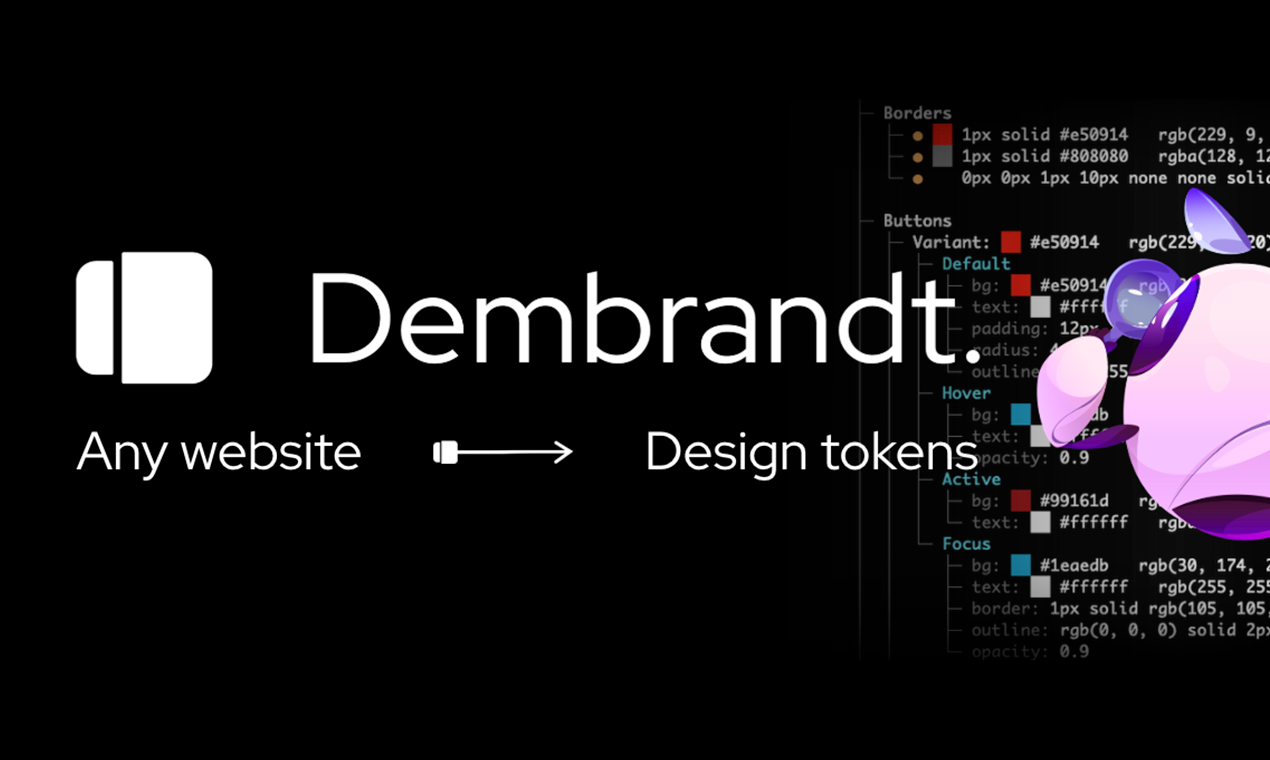
Extract a website's design system into design tokens in a few seconds: logo, colors, typography, borders, and more. One command.
Install
Install globally: npm install -g dembrandt
dembrandt example.com
Or use npx without installing: npx dembrandt example.com
Requires Node.js 18+
AI Agent Integration (MCP)
Use Dembrandt as a tool in Claude Code, Cursor, Windsurf, or any MCP-compatible client. Ask your agent to "extract the color palette from example.com" and it calls Dembrandt automatically.
claude mcp add --transport stdio dembrandt -- npx -y dembrandt-mcp
Or add to your project's .mcp.json:
{
  "mcpServers": {
    "dembrandt": {
      "command": "npx",
      "args": ["-y", "dembrandt-mcp"]
    }
  }
}
7 tools available: get_design_tokens, get_color_palette, get_typography, get_component_styles, get_surfaces, get_spacing, get_brand_identity.
What to expect from extraction?
- Colors (semantic, palette, CSS variables)
- Typography (fonts, sizes, weights, sources)
- Spacing (margin/padding scales)
- Borders (radius, widths, styles, colors)
- Shadows
- Components (buttons, badges, inputs, links)
- Breakpoints
- Icons & frameworks
Usage
dembrandt <url>                        # Basic extraction (terminal display only)
dembrandt example.com --json-only      # Output raw JSON to terminal (no formatted display, no file save)
dembrandt example.com --save-output    # Save JSON to output/example.com/YYYY-MM-DDTHH-MM-SS.json
dembrandt example.com --dtcg           # Export in W3C Design Tokens (DTCG) format (auto-saves as .tokens.json)
dembrandt example.com --dark-mode      # Extract colors from dark mode variant
dembrandt example.com --mobile         # Use mobile viewport (390x844) for responsive analysis
dembrandt example.com --slow           # 3x longer timeouts (24s hydration) for JavaScript-heavy sites
dembrandt example.com --brand-guide    # Generate a brand guide PDF
dembrandt example.com --design-md      # Generate a DESIGN.md file for AI agents
dembrandt example.com --pages 5        # Analyze 5 pages (homepage + 4 discovered pages), merges results
dembrandt example.com --sitemap        # Discover pages from sitemap.xml instead of DOM links
dembrandt example.com --pages 10 --sitemap # Combine: up to 10 pages discovered via sitemap
dembrandt example.com --no-sandbox     # Disable Chromium sandbox (required for Docker/CI)
dembrandt example.com --browser=firefox # Use Firefox instead of Chromium (better for Cloudflare bypass)
Default: formatted terminal display only. Use --save-output to persist results as JSON files. Browser automatically retries in visible mode if headless extraction fails.
Multi-Page Extraction
Analyze multiple pages to get a more complete picture of a site's design system. Results are merged into a single unified output with cross-page confidence boosting — tokens appearing on multiple pages get higher confidence scores.
# Analyze homepage + 4 auto-discovered pages (default: 5 total)
dembrandt example.com --pages 5

# Use sitemap.xml for page discovery instead of DOM link scraping
dembrandt example.com --sitemap

# Combine both: up to 10 pages from sitemap
dembrandt example.com --pages 10 --sitemap
Page discovery works two ways:
- DOM links (default): Reads navigation, header, and footer links from the homepage, prioritizing key pages like /pricing, /about, /features
- Sitemap (
--sitemap): Parses sitemap.xml (checks robots.txt first), follows sitemapindex references, and scores URLs by importance
Pages are fetched sequentially with polite delays. Failed pages are skipped without aborting the run.
Browser Selection
By default, dembrandt uses Chromium. If you encounter bot detection or timeouts (especially on sites behind Cloudflare), try Firefox which is often more successful at bypassing these protections:
# Use Firefox instead of Chromium
dembrandt example.com --browser=firefox

# Combine with other flags
dembrandt example.com --browser=firefox --save-output --dtcg
When to use Firefox:
- Sites behind Cloudflare or other bot detection systems
- Timeout issues on heavily protected sites
- WSL environments where headless Chromium may struggle
Installation:
Firefox browser is installed automatically with npm install. If you need to install manually:
npx playwright install firefox
W3C Design Tokens (DTCG) Format
Use --dtcg to export in the standardized W3C Design Tokens Community Group format:
dembrandt example.com --dtcg
# Saves to: output/example.com/TIMESTAMP.tokens.json
The DTCG format is an industry-standard JSON schema that can be consumed by design tools and token transformation libraries like Style Dictionary.
DESIGN.md
Use --design-md to generate a DESIGN.md file — a plain-text design system document readable by AI agents.
dembrandt example.com --design-md
# Saves to: output/example.com/DESIGN.md
Brand Guide PDF
Use --brand-guide to generate a printable PDF summarizing the extracted design system — colors, typography, components, and logo on a single document.
dembrandt example.com --brand-guide
# Saves to: output/example.com/TIMESTAMP.brand-guide.pdf
Local UI
Browse your extractions in a visual interface.
Setup
cd local-ui
npm install
Running
npm start
Opens http://localhost:5173 with API on port 3002.
Features
- Visual grid of all extractions
- Color palettes with click-to-copy
- Typography specimens
- Spacing, shadows, border radius visualization
- Button and link component previews
- Dark/light theme toggle
- Section nav links on extraction pages — jump directly to Colors, Typography, Shadows, etc. via a sticky sidebar
Extractions are performed via CLI (dembrandt <url> --save-output) and automatically appear in the UI.
Use Cases
- Design system documentation
- Multi-site design consolidation
- Internal design audits on your own properties
- Learning how design tokens map to real CSS
How It Works
Uses Playwright to render the page, reads computed styles from the DOM, analyzes color usage and confidence, groups similar typography, detects spacing patterns, and returns design tokens.
Extraction Process
- Browser Launch - Launches browser (Chromium by default, Firefox optional) with stealth configuration
- Anti-Detection - Injects scripts to bypass bot detection
- Navigation - Navigates to target URL with retry logic
- Hydration - Waits for SPAs to fully load (8s initial + 4s stabilization)
- Content Validation - Verifies page content is substantial (>500 chars)
- Parallel Extraction - Runs all extractors concurrently for speed
- Analysis - Analyzes computed styles, DOM structure, and CSS variables
- Scoring - Assigns confidence scores based on context and usage
Color Confidence
- High — Logo, primary interactive elements
- Medium — Secondary interactive elements, icons, navigation
- Low — Generic UI components (filtered from display)
- Only shows high and medium confidence colors in terminal. Full palette in JSON.
Limitations
- Dark mode requires
--dark-modeflag (not automatically detected) - Hover/focus states extracted from CSS (not fully interactive)
- Canvas/WebGL-rendered sites cannot be analyzed (no DOM to read)
- JavaScript-heavy sites require hydration time (8s initial + 4s stabilization)
- Some dynamically-loaded content may be missed
- Default viewport is 1920x1080 (use
--mobilefor 390x844 mobile viewport)
Intended Use
Dembrandt reads publicly available CSS and computed styles from website DOMs for documentation, learning, and analysis of design systems you own or have permission to analyze.
Only run Dembrandt against sites whose Terms of Service permit automated access, or against your own properties. Do not use extracted material to reproduce third-party brand identities, logos, or trademarks. Respect robots.txt, rate limits, and copyright.
Dembrandt does not host, redistribute, or claim rights to any third-party brand assets.
Contributing
Bugs, weird sites, pull requests — all welcome.
Open an Issue or PR.
@thevangelist
MIT — do whatever you want with it.
README copy captured when this server was indexed; it may lag the repository. The original is authoritative.