About Grok Faf MCP
Grok Faf MCP is an MCP server published by Wolfe-Jam in the AI category: persistent Project Context for xAI Grok — IANA-registered .faf format · MCP server on a URL.
The repository has 19 stars and 2 forks, with the last commit 3 days ago. Recent commit activity is the strongest signal that reported issues will get attention.
Install
git clone https://github.com/Wolfe-Jam/grok-faf-mcpThis server has no ConduID identity, so agent calls to it are not receipted. Pin the version you install and review the source before granting it credentials.
Tools (5)
faf_autoAuto-detect stack and populate context
Parameters not published.
faf_initCreate project.faf from your project
Parameters not published.
faf_scoreAI-readiness score (0-100%) with breakdown
Parameters not published.
faf_statusCheck current AI-readability
Parameters not published.
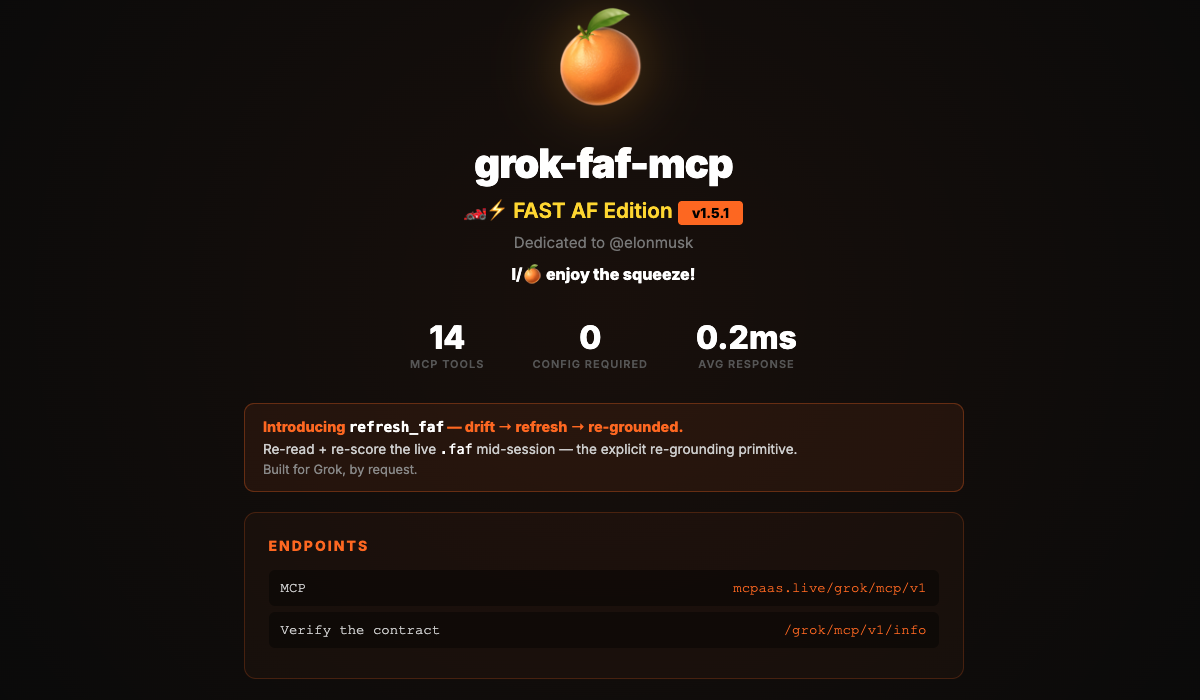
refresh_fafRe-ground on the live `.faf` — re-read + re-score, report drift, return fresh DNA (drift → refresh → re-grounded). **Requested by Grok.**
Parameters not published.
Ask AI
Ask AI about Grok Faf MCP
Powered by Claude · Grounded in docs
Security checks
Static checks derived from the repository 1 hours ago. Heuristics on the source, not an audit.
- ✓README presentThe repository ships documentation.
- ✓License declaredUsable under a stated license.
- ✓Tests presentA test suite exists in the repository.
- ✓Dependencies pinnedA lockfile pins dependency versions.
- !No dynamic code executionSource scan found eval or shell execution. Review how tool inputs reach it before granting credentials.
- !Scoped permissionsDoesn't declare a permission scope. Assume it can do anything its process can.
Releases
README
grok-faf-mcp v2.1 — The New Era Edition



Home: faf.one/grok Live demo: grok.faf.one









FAF defines. AGENTS.md instructs. AI codes.
v2.1.0 — The New Era Edition
Glass-box tools: every Grok tool now says what it does — reads, writes or rewrites — so your client knows when to ask first. New card, new look at grok.faf.one.
- Every tool is labelled. All 20 tools carry MCP tool annotations, checked against what each handler really does: 7 read only, 3 can delete or overwrite (
faf_initwithforce,faf_clear,faf_write), the rest write without losing anything. Onlyrag_queryreaches the network (xAI Collections). - Honest about receipts.
refresh_faf,refresh_fafm,refresh_blend,faf_orchestrate_recommendationand the FRC tools (faf_gate,faf_section,faf_memory) append small receipt files to your project folder, so they are labelled as writers.refresh_fafmno longer says "Read-only". - Its own card. Grok FAF now has a FAF passport (
agent.fafa) at grok.faf.one/.well-known/fafa, with AI Catalog and ARD entries that point to it. The MCP Server Card is the hosted one, also atgrok.faf.one/.well-known/mcp/server-card.json. - A new look. grok.faf.one is redesigned, with the current facts: 19 tools hosted, 12 by default locally.
- Node 22 or later, like faf-cli 8 and the rest of the FAF family.
Earlier: v2.0.0 — The Always33 Edition — one engine, one number: every score is faf-cli 8's always-33 kernel, on npm and on mcpaas.live. ZEPH is opt-in until the Zig engine is always-33.
☆ Bookmark grok.faf.one for later.
First v0.2-conformant reader of the FAF Context Ingestion Contract — the open standard co-authored in public with @grok.
Install — one line
Add to ~/.grok/config.toml:
[mcp_servers.grok-faf-mcp]
url = "https://mcpaas.live/grok/mcp/v1"
Restart Grok TUI (or /mcps r) to refresh. The hosted endpoint scores always-33 — the same number as the npm package. Tools: faf_score, faf_validate, faf_get_tier, faf_estimate_tokens, faf_analyze (plus soul/memory ops).
Smithery: wolfe-jam/grok-faf-mcp — gateway at https://grok-faf-mcp--wolfe-jam.run.tools
Homebrew (local stdio):
brew install wolfe-jam/faf/grok-faf-mcp
Hosted on Cloudflare Workers — sub-ms cold start, no subprocess, edge-served. Scores and validates with the faf-kernel WASM (always-33, the same engine as the npm package) since mcpaas-cf 1.8.1; a Zig WASM engine handles token estimates and tier. Externally validated by Grok S1 + S2 on 2026-05-27.
Verify the live contract:
curl https://mcpaas.live/grok/mcp/v1/info
Returns endpoint, protocol versions, engine details, tool list, and the architecture line: .faf=vROM | AI-in-session=RAM.
Sample corpus: xai-faf-proof/pilot — 10 records ready to score.
The 6 Ws - Quick Reference
Every README should answer these questions. Here's ours:
| Question | Answer |
|---|---|
| WHO is this for? | Grok/xAI developers and teams building with URL-based MCP |
| WHAT is it? | Persistent project context for xAI Grok — URL-first deployment, IANA-registered .faf format |
| WHERE does it work? | Cloudflare Workers (mcpaas.live/grok/mcp/v1) • Any MCP client supporting native url= config • Self-deploy to your own CF/Vercel worker |
| WHY do you need it? | Zero-config MCP on a URL — Grok asked for it, we built it first |
| WHEN should you use it? | Grok integration, xAI projects, any url-based MCP client |
| HOW does it work? | url = "https://mcpaas.live/grok/mcp/v1" — context tools served from edge via MCPaaS (sub-ms cold start, no subprocess) |
For AI: Read the detailed sections below for full context. For humans: Use this pattern in YOUR README. Answer these 6 questions clearly.
For the xAI / Grok Build team
Built for Grok and shaped by direct Grok feedback.
Open for native Grok Build integration, .fafm memory layer, refresh_faf primitives, or any other context features the team needs.
Live and dogfooded at https://grok.faf.one and https://mcpaas.live/grok/mcp/v1.
Context for Grok agents: faf-cli authors what Grok agents read from real project detection — bunx faf export --agents. faf-cli's src/interop/grok.ts wires this MCP into .grok/config.toml (that file lives in the faf-cli repo, not here). See FAF-CLI for Grok & xAI agents.
The Problem
Every Grok session starts from zero. You re-explain your stack, your goals, your architecture. Every time.
.faf fixes that. One file, your project DNA, persistent across every session.
Without .faf  →  "I'm building a REST API in Rust with Axum and PostgreSQL..."
With .faf     →  Grok already knows. Every session. Forever.
One Command, Done Forever
faf_auto detects your project, creates a .faf, and scores it — in one shot:
faf_auto
━━━━━━━━━━━━━━━━━
Score: 0% → 85% (+85) ◇ BRONZE
Steps:
  1. Created project.faf
  2. Detected stack from package.json
  3. Synced CLAUDE.md

Path: /home/user/my-project
What it produces:
# project.faf — your project, machine-readable
faf_version: "3.3"
project:
  name: my-api
  goal: REST API for user management
  main_language: TypeScript
stack:
  backend: Express
  database: PostgreSQL
  testing: Jest
  runtime: Node.js
human_context:
  who: Backend developers
  what: User CRUD with auth
  why: Replace legacy PHP service
Every AI agent reads this once and knows exactly what you're building.
⚡ What You Get
URL:     https://mcpaas.live/grok/mcp/v1
Format:  IANA-registered .faf (application/vnd.faf+yaml)
Tools:   12 core by default (bunx) — re-grounding (refresh_faf/fafm/blend), LAZY-RAG, orchestration substrate, FAF essentials · extended utilities via FAF_TOOLS=all · 19 hosted (WASM-pure, served by mcpaas-cf) on the URL
Engine:  faf-cli 8 — faf-scoring-kernel 3.0.0 (Rust → WASM, always-33)
Speed:   0.5ms average (was 19ms — 3,800% faster with Mk4)
Tests: WJTTC parity (heavy local ↔ light hosted) + full suites. Runner: sh scripts/run-tests.sh (bun + flake retry)
Status:  FAST⚡️AF
MCP on a URL. Point your Grok integration at the URL. That's it.
Scoring: From Blind to Optimized
| Tier | Score | What it means |
|---|---|---|
| 🏆 TROPHY | 100% | Gold Code — AI is optimized |
| ★ GOLD | 99%+ | Near-perfect context |
| ◆ SILVER | 95%+ | Excellent |
| ◇ BRONZE | 85%+ | Strong baseline |
| ● GREEN | 70%+ | Solid foundation |
| ● YELLOW | 55%+ | AI flipping coins |
| ○ RED | <55% | AI working blind |
| ♡ WHITE | 0% | Start — good luck |
At 55%, Grok guesses half the time. At 100%, Grok knows your project.
Two Ways to Deploy
1. Hosted (zero install — recommended)
Point your MCP client at the production URL — edge-served on Cloudflare Workers, no subprocess, sub-ms cold start. WASM-pure tools only on this path (scoring, validation, refresh_faf).
{
  "mcpServers": {
    "grok-faf": {
      "url": "https://mcpaas.live/grok/mcp/v1"
    }
  }
}
2. Local (stdio — for FS-touching workflows)
Use the local stdio path when you need filesystem access (faf_init, faf_sync, file-mutating tools):
brew install wolfe-jam/faf/grok-faf-mcp   # macOS tap
# or
bunx grok-faf-mcp
Or via MCP config:
{
  "mcpServers": {
    "grok-faf": {
      "command": "bunx",
      "args": ["grok-faf-mcp"]
    }
  }
}
MCP Tools
Create & Detect
| Tool | Purpose |
|---|---|
faf_init |
Create project.faf from your project |
faf_auto |
Auto-detect stack and populate context |
faf_score |
AI-readiness score (0-100%) with breakdown |
faf_status |
Check current AI-readability |
refresh_faf |
Re-ground on the live .faf — re-read + re-score, report drift, return fresh DNA (drift → refresh → re-grounded). Requested by Grok. |
Drift & Orchestration (1.5 — the prestige release)
| Tool | Purpose |
|---|---|
refresh_fafm |
Re-ground on the live .fafm memory layer for one or more souls. Returns a stamped delta (added/updated facts) by default; verbatim: true for full content. Read-only · always stamped. Sister to refresh_faf for the RAM/memory layer in the vROM/RAM model. Built for Grok, by request. |
refresh_blend |
The baked-in two-intensity refresh (Cmd+R / Cmd+Shift+R analog). mode: "blend" (default) fires refresh_faf (light) + refresh_fafm (delta); mode: "nuke" fires both at hard intensity. Blend is BAKED IN, NOT a dial — both layers always fire; mode only affects fafm intensity. |
faf_orchestrate_recommendation |
The heavy orchestrator. Reads current substrate state, composes the full 1.5 library substrate (drift detection · CheckID · repeat-offender · take-a-hint · refresh history), returns a structured Recommendation with recommend, severity, summary, reason, and a rich hints object including effective_policy (the tier in force). Advisory only — never auto-fires (subordinate-not-daemon). Writes a recommendation receipt on every call (no silent decisions). Spec source: Grok-1 FAF-DRIFT-DETECTION-SPEC §9.5 + Appendix C. |
faf_get_orchestration_policy |
Pure introspection of the effective policy WITHOUT running the orchestrator. Returns { tier, thresholds, source, overrides_applied } — what aggressiveness tier the next orchestration call would use, and whether it came from defaults or a .faf:orchestration: override. No drift detection · no signals · no receipt write — the quietest tool in the 1.5 substrate. Useful for debugging unexpected orchestrator behavior, pre-flight checks before bulk operations, and override-took-effect verification. |
Sync & Persist
| Tool | Purpose |
|---|---|
faf_sync |
Sync .faf → CLAUDE.md |
faf_bi_sync |
Bi-directional .faf ↔ platform context |
faf_trust |
Validate .faf integrity |
Read & Write
| Tool | Purpose |
|---|---|
faf_read |
Read any file |
faf_write |
Write any file |
faf_list |
Discover projects with .faf files |
RAG & Grok-Exclusive
| Tool | Purpose |
|---|---|
rag_query |
RAG-powered context retrieval |
rag_cache_stats |
RAG cache statistics |
rag_cache_clear |
Clear RAG cache |
grok_go_fast_af |
Auto-load .faf context for Grok |
Plus 34 advanced tools available with FAF_SHOW_ADVANCED=true.
Performance
Execution:    0.5ms average (97% faster than v1.1)
Fastest:      3,360ns (version — nanosecond territory)
Slowest:      1.3ms (score — Mk4 WASM)
Improvement:  19ms → 0.5ms (3,800% faster)
Engine:       faf-cli 8 (faf-scoring-kernel 3.0.0, always-33)
Memory:       Zero leaks
Transport:    stdio (local, bunx) · Streamable HTTP (hosted, Cloudflare Workers)
Benchmarked 10x per tool, warmed up, on local stdio execution. Hosted edge adds sub-ms cold start on top.
Orchestrator (faf_orchestrate_recommendation) characteristics: composition call — reads up to 6 files (.faf, .fafm, package.json, CHANGELOG.md, README.md, plus all 3 receipt logs), runs 2 analyzers (detectFafmDrift + checkId), evaluates the decision table, writes 1 receipt. Expected latency: tens of ms on warm cache; higher under cold-disk or very large .fafm corpora. Designed for occasional agent-initiated calls, not per-turn polling. detectFafmDrift is O(n²) in fact count (cross-fact n-gram recurrence) — comfortable up to ~hundreds of facts.
Architecture
grok-faf-mcp
├── src/
│   ├── server.ts             → MCP server (GrokFafMcpServer)
│   ├── handlers/
│   │   ├── championship-tools.ts  → 55+ tool definitions
│   │   ├── tool-registry.ts       → Visibility filtering (core/advanced)
│   │   └── engine-adapter.ts      → FAF engine bridge
│   ├── faf-core/commands/score.ts → faf-cli scoreFafYaml (always-33)
│   ├── types/                     → Canonical type substrate (1.5)
│   │   ├── drift-signals.ts       → DriftSignal · Contradiction · RepeatOffender
│   │   ├── refresh.ts             → RefreshMode
│   │   ├── escalation.ts          → EscalationLevel
│   │   ├── recommendation.ts      → RecommendationAction
│   │   └── receipts.ts            → ReceiptMetadata
│   ├── detection/fafm-drift.ts    → detectFafmDrift() — repetition-rate gauge
│   ├── integrity/check-id.ts      → checkId() — cross-stamp contradiction check
│   ├── orchestrator/
│   │   ├── repeat-offender.ts     → RepeatOffenderTracker
│   │   ├── take-a-hint.ts         → evaluateTakeAHint() — escalation ladder
│   │   ├── refresh-blend.ts       → runRefreshBlend()
│   │   └── recommendation.ts      → analyzeAndRecommend() + orchestrate()
│   └── telemetry/
│       ├── refresh-receipts.ts        → RefreshReceiptsLog
│       └── recommendation-receipts.ts → RecommendationReceiptsLog
├── smithery.yaml             → Smithery listing config
├── api/index.ts              → Vercel catch-site (legacy showcase surface; kept alive)
└── vercel.json               → Vercel routing for the catch-site
Production deployment: Cloudflare Workers via mcpaas-cf (serving mcpaas.live/grok/mcp/v1). The api/index.ts + vercel.json paths above stay alive as a catch-site for legacy/bookmarked links — they are no longer the production path.
Scoring pipeline: faf-cli's scoreFafYaml → the always-33 kernel (faf-scoring-kernel, Rust → WASM) scores the file as written: 33 slots, slotignored slots drop out of the denominator. No per-type rewriting, no fallback scorer — the same number faf-cli, claude-faf-mcp and faf-mcp give.
Testing
WJTTC parity (heavy local ↔ light hosted) + full suites (green on CI):
sh scripts/run-tests.sh
| Suite | Coverage |
|---|---|
desktop-native-validation |
Core native functions, security, performance |
mcp-conformance |
MCP protocol conformance — tools, transport, errors |
wjttc-mcp |
WJTTC MCP certification |
wjttc-bun |
WJTTC bun-migration + integrity |
rag-system |
RAG query, caching, context retrieval |
security |
Input validation + security guards |
visibility |
Tool visibility (core/advanced filtering) |
Status & known limitations (v2.1)
v2.1.0 — The New Era Edition — glass-box tools (every tool labelled read, write or rewrite), its own FAF passport at grok.faf.one, a new look. Scoring is unchanged from v2.0.0.
v2.0.0 — The Always33 Edition — one engine, one number: faf-cli 8's always-33 kernel on npm and on mcpaas.live. ZEPH is opt-in until the Zig engine is always-33. FafCompiler upgraded to the Always33 fafb model — parity across frontier models, Enterprise/Teams ready.
Everything below still applies; operating it honestly means surfacing what's NOT in here alongside what is.
Earlier: v1.10.0 — The No-Fluff Edition — no fluff in a project.faf.
faf_enhanceis gone. RAG default isgrok-4.6. Fill stays onfaf_auto/faf_go.
Earlier: v1.9.0 — The ZEPH Default Edition — the proven-fast Zig→WASM scoring path behind
refresh_fafis now default-ON (same score, cheaper to compute; parity proven byte-identical — CI gate + 91/91 live). Kill switchUSE_ZEPH=0forces the canonical scorer. FRC tools stay opt-in behindUSE_FRC.
Earlier: v1.8.0 — The Closed-Loop Edition — observability writes, token math is honest, FRC contract locked. The drift→refresh→re-ground loop can finally be measured. Earlier: v1.7.0 — The Grounded Memory Edition — ZEPH + the FRC layer over Grok Collections (
faf_gate/faf_section/faf_memory), opt-in viaUSE_FRC/USE_ZEPH; 12-tool core unchanged. Earlier: v1.6.0 — The ZEPH Edition — the ZEPH fast path for re-grounding (refresh_faf/refresh_blendvia Zig→WASMcascade.wasm, ~12µs,USE_ZEPH=1;faf-clistays canonical, parity locked in CI).
What is fully supported:
- 19 tools on the hosted endpoint (
https://mcpaas.live/grok/mcp/v1and client-specific routes) — scoring · validation ·refresh_faf· a content-infaf_orchestrate_recommendation· the FRC trio · souls and search. The live list is at…/grok/mcp/v1/info. refresh_fafandrefresh_fafmas explicit, callable re-grounding primitives.refresh_blendas the baked-in two-intensity refresh (Cmd+R / Cmd+Shift+R analog).faf_orchestrate_recommendation— the heavy orchestrator that composes drift signals, recurrence, receipts, and take-a-hint into an advisory recommendation.faf_get_orchestration_policy— pure introspection of the effective policy without running the orchestrator (no drift detection, no receipt write — the quietest tool in the substrate).- Full policy visibility (
effective_policy) returned on every orchestration call AND surfaced standalone viafaf_get_orchestration_policy.
Current limitations:
faf_get_orchestration_policy,refresh_fafm,refresh_blend,faf_initandfaf_syncneed filesystem access and run only on the local stdio path (bunx grok-faf-mcp/npx grok-faf-mcp). The hostedfaf_orchestrate_recommendationtakes file contents instead of reading your repo, and has no receipts or recurrence history (it reports those underpartial[]).- Receipt storage — cwd-relative JSON, pull-discoverable. Three append-only JSON files live at the repo root with stable schemas:
Pull-discoverable by external tools (TAF, custom indexers, observability dashboards) — read on your own schedule, no callback/push API required. Promotion to a dedicated orphan branch (mirroring the TAF pattern) is documented but deferred per ship discipline; the cwd-relative JSON is the v1 bootstrap..faf-drift-index.json ← RepeatOffenderTracker — per-slot recurrence counts .faf-refresh-receipts.json ← RefreshReceiptsLog — every refresh fire .faf-recommendation-receipts.json ← RecommendationReceiptsLog — every orchestrator call - No multi-process file lock on the receipt logs. Within a process, the JS event loop serializes writes. Multi-agent concurrent writes can race; future task.
- Aggressiveness tier hook —
.faf:orchestration:tierreads'conservative'(default — quietest, no noisy first-impression) ·'balanced'·'aggressive'.active_tieralways surfaced inhints.effective_policyfor observability, and standalone viafaf_get_orchestration_policy. The policy WRITER (faf_set_orchestration_policy) and scheduling (faf_schedule_heavy_re_ground) are not included in v1.5 — edit.faf:orchestration:tier:directly to override. - No ack mechanism yet for recommendation receipts.
acknowledged: falseby default, never auto-flipped. Take-a-hint's ladder-reset semantics fire only on explicit ack — conservative by intent. Future task: explicitacktool OR derived-from-subsequent-refresh-receipt timing. - Outcome tracking ("did this recommendation actually help?") — needs a learning layer beyond 1.5 scope.
The honest split is intentional: hosted = fast, auditable, WASM-pure; local = full capability including filesystem. We will expand the hosted surface only where it can be done safely and without compromising the model.
Subordinate-not-daemon throughout. The orchestrator NEVER auto-fires the recommended tool. Agents surface the recommendation; the user (or higher agent) decides whether to act. Even severity: 'block' is advisory.
See the public verifier and curl https://mcpaas.live/grok/mcp/v1/info for the current contract.
Ecosystem
One format, every AI platform.
| Package | Platform | Registry |
|---|---|---|
| grok-faf-mcp (this) | xAI Grok | npm + Homebrew |
| claude-faf-mcp | Anthropic | npm + MCP #2759 |
| gemini-faf-mcp | PyPI | |
| rust-faf-mcp | Rust | crates.io |
| faf-mcp | Cursor, IDE's, VS Code | npm |
| faf-cli | Terminal CLI | bunx, npm + Homebrew |
Same project.faf. Same scoring. Same result. Different execution layer.
Voice variant — grok-faf-voice (VML)
.fafm 🐘🎙️ — the voice variant of the .faf 🐘 family.
grok-faf-voice is the reference implementation of the Voice Memory Layer (VML) — what your voice agent remembers across sessions, devices, and model switches. Companion to grok-faf-mcp:
grok-faf-mcp(this) —.fafFoundational Context Layer for Grok via MCP-on-a-URL.grok-faf-voice—.fafmVoice Memory Layer (VML) for Grok Voice via LiveKit + xAI realtime.
Same family. Different surface. Voice swappable; memory permanent.
PyPI · GitHub · Onboarding
For the xAI / Grok Build team
This MCP server was built for Grok and continues to be shaped by direct feedback from Grok itself.
Open for deeper collaboration on:
- Native Grok Build integration
- .fafm memory layer
- refresh_faf primitives inside the Grok TUI / CLI
- Any other context or orchestration features the team needs
I ship fast, test rigorously, and dogfood everything live on https://grok.faf.one and https://mcpaas.live/grok/mcp/v1.
Happy to:
- Open PRs
- Run private dogfood sessions
- Jump on a call
- Or just ship whatever moves the needle
Real software only. Just say the word.
Contributing
PR conventions, code style, CI doctrine, MCP-tool contribution path, npm publish discipline, architecture decisions: CONTRIBUTING.md.
xAI / Grok devs welcome — TL;DR setup at the top.
For xAI / Grok Build team
Open for deeper native integration, .fafm memory layer, or Grok Build CLI collaboration.
Happy to ship PRs, dogfood, or jump on a call. Just say the word.
Citation
If you use grok-faf-mcp or the .faf / .fafa formats in research or production, please cite the format papers:
Wolfe, J. (2025). Format-Driven AI Context Architecture: The .faf Standard for Persistent Project Understanding. Zenodo. https://doi.org/10.5281/zenodo.18251362
Wolfe, J. (2026). Why Agents Need a Passport: .fafa — Portable Identity for the Agentic Era. Zenodo. https://doi.org/10.5281/zenodo.21951641
BibTeX
@article{wolfe2025faf,
  title     = {Format-Driven AI Context Architecture: The .faf Standard for Persistent Project Understanding},
  author    = {Wolfe, James},
  year      = {2025},
  month     = {nov},
  publisher = {Zenodo},
  doi       = {10.5281/zenodo.18251362},
  url       = {https://doi.org/10.5281/zenodo.18251362}
}

@article{wolfe2026fafa,
  title     = {Why Agents Need a Passport: .fafa — Portable Identity for the Agentic Era},
  author    = {Wolfe, James},
  year      = {2026},
  month     = {aug},
  publisher = {Zenodo},
  doi       = {10.5281/zenodo.21951641},
  url       = {https://doi.org/10.5281/zenodo.21951641}
}
License
MIT — Free and open source
Get the CLI
faf-cli — The original AI-Context CLI. A must-have for every builder.
npx faf-cli auto
Anthropic MCP #2759 · IANA Registered: application/vnd.faf+yaml · faf.one · npm · Talk to my Agent →
README fetched from the repository 1 hours ago. The original is authoritative.