About Arrakis
Arrakis is an MCP server published by abshkbh in the Developer Tools category: a fully customizable and self-hosted sandboxing solution for AI agent code execution and computer use. It features out-of-the-box support for backtracking, a simple REST API and Python SDK, automatic port forwarding, and secure MicroVM isolation. Perfect for safely running, testing, and backtracking multi-step agent workflows.
The repository has 888 stars and 89 forks, with the last commit a year ago. Six months or more without a commit doesn't mean the server is broken, but check the open issues before depending on it in production.
Install
git clone https://github.com/abshkbh/arrakisThis server has no ConduID identity, so agent calls to it are not receipted. Pin the version you install and review the source before granting it credentials.
Ask AI
Ask AI about Arrakis
Powered by Claude · Grounded in docs
Security checks
Static checks derived from the repository 4 days ago. Heuristics on the source, not an audit.
- ✓README presentThe repository ships documentation.
- ✓License declaredUsable under a stated license.
- !Tests presentNo tests found. Behaviour changes may go unnoticed between versions.
- ✓Dependencies pinnedA lockfile pins dependency versions.
- !No dynamic code executionSource scan found eval or shell execution. Review how tool inputs reach it before granting credentials.
- !Scoped permissionsDoesn't declare a permission scope. Assume it can do anything its process can.
Releases
README

Arrakis

Introduction
AI agents can generate malicious or buggy code that can attack the host system its run on.
Many agents have elaborate multi-step plans to achieve their goals and benefit from the ability to backtrack to intermediate states.
Arrakis provides a secure, fully customizable, and self-hosted solution to spawn and manage Sandboxes for code execution and computer use. It has out-of-the box support for backtracking via snapshot-and-restore.
-
Secure by design, each sandbox runs in a MicroVM.
-
Each sandbox runs Ubuntu inside with a code execution service and a VNC server running at boot.
-
A REST API, Python SDK py-arrakis, and a MCP server let clients (both humans and AI Agents) programatically spawn sandboxes, upload files, and execute code inside each sandbox.
-
Automatically sets up and manages port forwarding from the self-hosted public server to the sanboxes running on it i.e. clients can easily access the sandbox GUI (including Chrome for computer use) without extra setup.
-
Supports snapshot-and-restore out of the box i.e. AI Agents can do some work, snapshot a sandbox, and later backtrack to the exact previous state by restoring the snapshot. This means any processes spawned, files modified etc. will be restored as is inside the sandbox.Useful for Monte Carlo Tree Search based agents or explainability of elaborate agent execution flows.
Table of Contents
Demo
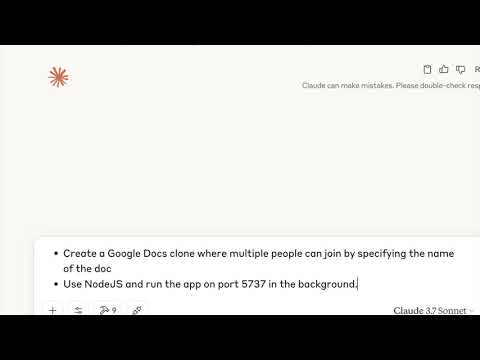
Watch Claude code a live Google docs clone using Arrakis via MCP. It even snapshots the sandbox to checkpoint progress.
Setup
Prerequisites
-
cloud-hypervisoronly works with/dev/kvmfor virtualization on Linux machines. Hence, we only support Linux machines. -
Check if virtualization is enabled on the host by running.
stat /dev/kvm
GCP Setup
- Follow the instructions in GCP Setup to set up Arrakis on GCE VM.
Quick setup using prebuilts
- You can leverage our setup.sh script and prebuilt binaries to easily set up Arrakis.
curl -sSL https://raw.githubusercontent.com/abshkbh/arrakis/main/setup/setup.sh | bash
ls arrakis-prebuilt
Run the arrakis-restserver
- Now we have a folder with all binaries and images pulled. We always need to run
arrakis-restserverfirst.cd arrakis-prebuilt sudo ./arrakis-restserver
Use the CLI or py-arrakis
- You can use the CLI or py-arrakis to spawn and manage VMs.
cd arrakis-prebuilt
./arrakis-client start -n agent-sandbox
Quickstart
SDK
Arrakis comes with a Python SDK py-arrakis that lets you spawn, manage, and interact with VMs seamlessly.
-
Install the SDK
pip install py-arrakis -
Follow the instructions in Usage to run the
arrakis-restserveron a Linux machine, or download pre-built binaries from the official releases page. -
Use py-arrakis to interact with
arrakis-restserver. -
Run untrusted code
# Replace this with the ip:port where `arrakis-restserver` is running. sandbox_manager = SandboxManager('http://127.0.0.1:7000') # Start a new sandbox. with sb as sandbox_manager.start_sandbox('agent-sandbox'): sb.run_cmd('echo hello world') # Sandbox `sb` automatically destroyed when the context is exited. -
Snapshot and restore a sandbox
# Start a sandbox and write some data to a file.
sandbox_name = 'agent-sandbox'
sandbox = sandbox_manager.start_sandbox(sandbox_name)
sandbox.run_cmd("echo 'test data before snapshot' > /tmp/testfile")
snapshot_id = sandbox.snapshot("initial-state")
sandbox.run_cmd("echo 'test data after snapshot' > /tmp/testfile")

# Destroy the sandbox.
sandbox.destroy()

# Restore the sandbox from the snapshot and verify we have the same data at the time of the
# snapshot.
sandbox = sandbox_manager.restore(sandbox_name, snapshot_id)
result = sandbox.run_cmd("cat /tmp/testfile")
# result["output"] should be "test data before snapshot".
MCP
-
Arrakis also comes with a MCP server that lets MCP clients like Claude Desktop App, Windsurf, Cursor etc.. spawn and manage sandboxes.
-
Here is a sample
claude_desktop_config.json{ "mcpServers": { "arrakis": { "command": "/Users/username/.local/bin/uv", "args": [ "--directory", "/Users/username/Documents/projects/arrakis-mcp-server", "run", "arrakis_mcp_server.py" ] } } }
GUI For Computer Use

-
Every sandbox comes with a VNC server running at boot. It also comes with Chrome pre-installed.
-
Arrakis also handles port forwarding to expose the VNC server via a port on the dev server running
arrakis-restserver. -
Start a sandbox and get metadata about the sandbox including the VNC connection details.
# Replace this with the ip:port where `arrakis-restserver` is running. sandbox_manager = SandboxManager('http://127.0.0.1:7000') sb = sandbox_manager.start_sandbox('agent-sandbox') print(sb.info()) -
We can get the VNC connection details from the
port_forwardsfield in the response. The VNC server is represented by the descriptionguiin a port forward entry. We will use thehost_portfield to connect to the VNC server.{ 'name': 'agent-sandbox', 'status': 'RUNNING', 'ip': '10.20.1.2/24', 'tap_device_name': 'tap0', 'port_forwards': [{'host_port': '3000', 'guest_port': '5901', 'description': 'gui'}] } -
Use any VNC client to connect to the VNC server to access the GUI.
# We see port 3000 is the host port forwarded to the VNC server running inside the sandbox.
./utils/novnc_proxy --vnc <dev-server-ip>:3000
CLI Usage
-
Arrakis comes with an out-of-the-box CLI client that you can use to spawn and manage VMs.
-
Start arrakis-restserver as detailed in the Setup section.
-
In a separate shell we will use the CLI client to create and manage VMs.
-
Start a VM named
foo. It returns metadata about the VM which could be used to interacting with the VM../out/arrakis-client start -n foostarted VM: {"codeServerPort":"","ip":"10.20.1.2/24","status":"RUNNING","tapDeviceName":"tap-foo","vmName":"foo"} -
SSH into the VM.
- ssh credentials are configured here.
# Use the IP returned. Password is "elara0000" ssh elara@10.20.1.2 -
Inspecting a VM named
foo../out/arrakis-client list -n fooVM: {"ip":"10.20.1.2/24","status":"RUNNING","tapDeviceName":"tap-foo","vmName":"foo"} -
List all the VMs.
./out/arrakis-client list-allVMs: {"vms":[{"ip":"10.20.1.2/24","status":"RUNNING","tapDeviceName":"tap-foo","vmName":"foo"}]} -
Stop the VM.
./out/arrakis-client stop -n foo -
Destroy the VM.
./out/arrakis-client destroy -n foo -
Snapshotting and Restoring the VM.
- We support snapshotting the VM and then using the snapshot to restore the VM. Currently, we restore the VM to use the same IP as the original VM. If you plan to restore the VM on the same host then either stop or destroy the original VM before restoring. In the future this won't be a constraint.
./out/arrakis-client snapshot -n foo-original -o foo-snapshot./out/arrakis-client destroy -n foo-original -o foo-snapshot./out/arrakis-client restore -n foo-original --snapshot foo-snapshot
Architecture And Features

arrakis includes the following services and features
-
REST API
- arrakis-restserver
- A daemon that exposes a REST API to start, stop, destroy, list-all VMs. Every VM started is managed by this server i.e. the lifetime of each VM is tied to the lifetime of this daemon.
- The api is present at api/server-api.yaml.
- Code
- arrakis-client
- A Golang CLI that you can use to interact with arrakis-restserver to spawn and manage VMs.
- Code
- arrakis-restserver
-
Python SDK
- Checkout out the official Python SDK - py-arrakis
-
Security
- Each sandbox runs in a MicroVM.
- MicroVMs are lightweight Virtual Machines (compared to traditional VMs) powered by Rust based Virtual Machine Managers such as firecracker and cloud-hypervisor.
- Arrakis uses cloud-hypervisor as the VMM.
- Any untrusted code executed within the sandbox is isolated from the host machine as well as other agents.
- We use overlayfs to also protect the root filesystem of each sandbox.
- Each sandbox runs in a MicroVM.
-
Customization
- Dockerfile based rootfs customization.
- Easily add packages and binaries to your VM's rootfs by manipulating a Dockerfile.
- Out of the box networking setup for the guest.
- Each sandbox gets a tap device that gets added to a Linux bridge on the host.
- ssh access to the sandbox.
- Prebuilt Linux kernel for the sandbox
- Or pass your own kernel to arrakis-client while starting VMs.
- Dockerfile based rootfs customization.
Customization
- Detailed README goes over how to customize the default packages and binaries running in a sandbox.
Contribution
Thank you for considering contributing to arrakis! 🎉
Feel free to open a PR. A detailed contribution guide is going to be available soon.
Legal Info
Contributor License Agreement
In order for us to accept patches and other contributions from you, you need to adopt our Arrakis Contributor License Agreement (the "CLA"). Please drop a line at abshkbh@gmail.com to start this process.
Arrakis uses a tool called CLA Assistant to help us keep track of the CLA status of contributors. CLA Assistant will post a comment to your pull request indicating whether you have signed the CLA or not. If you have not signed the CLA, you will need to do so before we can accept your contribution. Signing the CLA would be one-time process, is valid for all future contributions to Arrakis, and can be done in under a minute by signing in with your GitHub account.
License
By contributing to Arrakis, you agree that your contributions will be licensed under the GNU Affero General Public License v3.0 and as commercial software.
License
This project is licensed under the GNU Affero General Public License v3.0. For commercial licensing, please drop a line at abshkbh@gmail.com.
README fetched from the repository 4 days ago. The original is authoritative.