About Backlog
Backlog is an MCP server in the Productivity category: mCP Server for backlog.
The repository has 17 stars and 0 forks.
Install
claude mcp add backlog -- npx -y @cuongph.dev/backlog-mcpnpx -y @cuongph.dev/backlog-mcpThis server has no ConduID identity, so agent calls to it are not receipted. Pin the version you install and review the source before granting it credentials.
Ask AI
Ask AI about Backlog
Powered by Claude · Grounded in docs
Security checks
- ✓README presentThe repository ships documentation.
5 checks have not been run yet.
README
backlog-mcp
A task backlog MCP server for LLM agents. Works with any MCP client — Claude, Kiro, Cursor, Codex, etc.
Agents create tasks, track progress, attach artifacts, and search across everything. Humans get a real-time web viewer to see what agents are doing.
Runs locally out of the box. Can also be self-hosted on Cloudflare Workers + D1 for a free, always-on remote backlog accessible from any device or MCP client.
Quick start: Tell your LLM:
Add backlog-mcp to .mcp.json and use it to track tasks
Live demo: backlog-mcp-viewer.pages.dev — the viewer UI connected to a real hosted instance
What's Inside
This is a monorepo with 3 packages:
| Package | npm | What it does |
|---|---|---|
packages/server |
backlog-mcp |
MCP server, HTTP API, CLI |
packages/viewer |
— | Web UI built on @nisli/core |
packages/shared |
— | Shared entity types and ID utilities |
The viewer is built with Nisli, a zero-dependency reactive Web Component framework published as @nisli/core. Nisli started in this repo and now lives separately.
Installation
Add to your MCP config (.mcp.json or your MCP client config):
{
  "mcpServers": {
    "backlog": {
      "command": "npx",
      "args": ["-y", "backlog-mcp"]
    }
  }
}
Self-Hosting on Cloudflare (Optional)
Host your own always-on remote backlog for free using Cloudflare Workers + D1. Accessible from any device or MCP client — no local server process required.
Prerequisites: Cloudflare account (free tier is enough), wrangler CLI, a GitHub OAuth App.
# 1. Clone and install
git clone https://github.com/gkoreli/backlog-mcp.git
cd backlog-mcp
pnpm install

# 2. Create the D1 database
cd packages/server
npx wrangler d1 create backlog
# Copy the database_id into packages/server/wrangler.jsonc

# 3. Apply the D1 migrations
npx wrangler d1 execute backlog --remote --file=migrations/0001_initial.sql
npx wrangler d1 execute backlog --remote --file=migrations/0002_oauth_refresh_tokens.sql

# 4. Set secrets
npx wrangler secret put JWT_SECRET          # any strong random string
npx wrangler secret put API_KEY             # your personal API key (for Claude Desktop)
npx wrangler secret put GITHUB_CLIENT_ID    # GitHub OAuth App client ID
npx wrangler secret put GITHUB_CLIENT_SECRET
npx wrangler secret put ALLOWED_GITHUB_USERNAMES  # comma-separated: "you,youralt"

# 5. Deploy
npx wrangler deploy
GitHub OAuth App setup: go to GitHub → Settings → Developer settings → OAuth Apps → New.
Set the callback URL to https://<your-worker>.workers.dev/oauth/github/callback.
Once deployed, add to your MCP client config:
{
  "mcpServers": {
    "backlog": {
      "command": "npx",
      "args": ["-y", "mcp-remote", "https://<your-worker>.workers.dev/mcp"]
    }
  }
}
Claude.ai and ChatGPT can connect directly via the remote MCP URL — no local process needed. GitHub OAuth sessions use rotating refresh tokens so clients can renew access without daily re-authentication.
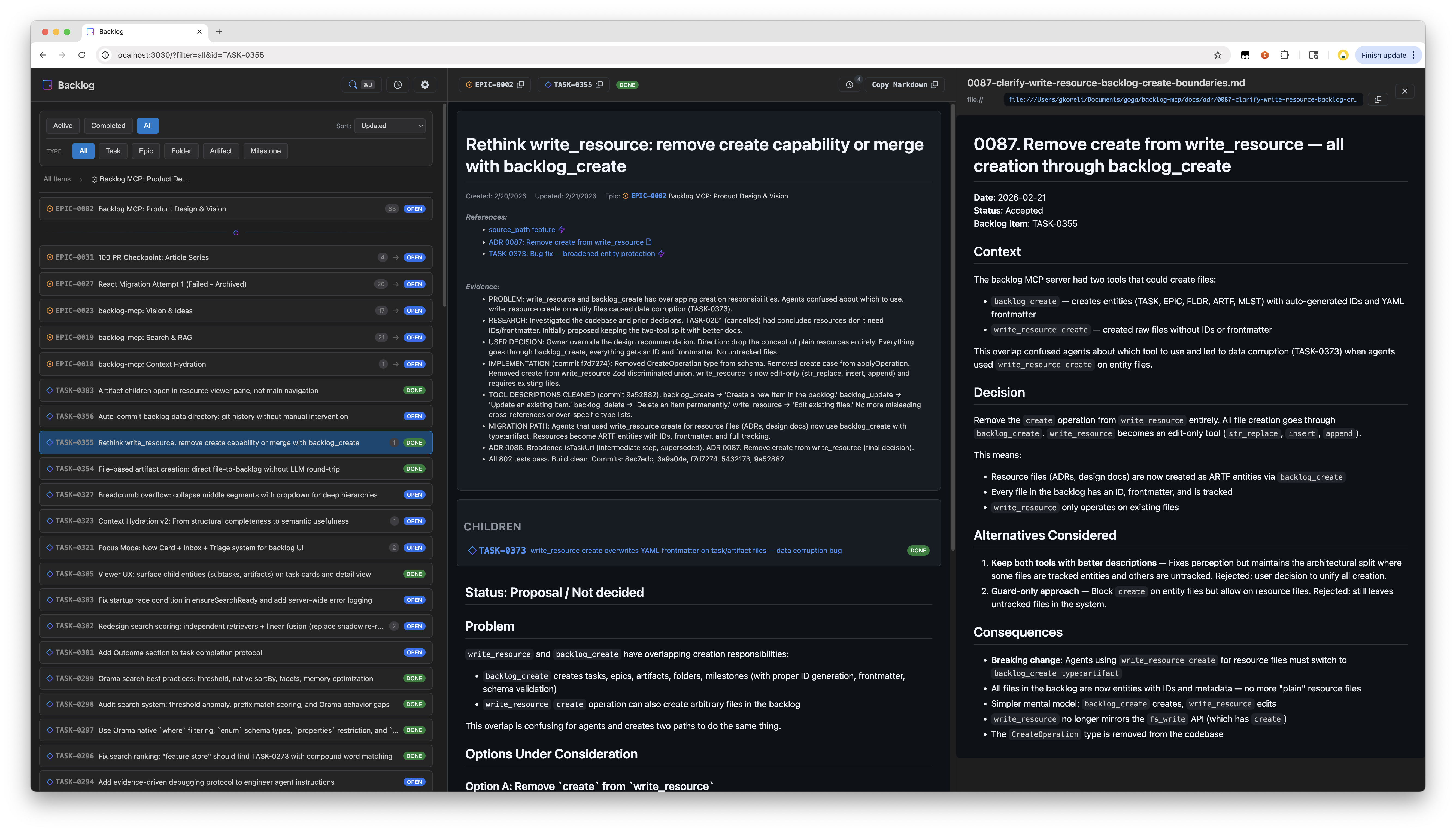
Web Viewer
Open http://localhost:3030 — always available when the server is running.
Features:
- Split pane layout with task list and detail view
- Spotlight search with hybrid text + semantic matching
- Real-time updates via SSE
- Activity timeline
- Filter by status, type, epic
- GitHub-style markdown rendering with Mermaid diagrams
- URL state persistence
The viewer UI is built with Nisli (@nisli/core).
Entity Types
5 entity types, all stored as markdown files with YAML frontmatter:
| Type | Prefix | Purpose |
|---|---|---|
| Task | TASK-0001 |
Work items |
| Epic | EPIC-0001 |
Groups of related tasks |
| Folder | FLDR-0001 |
Organizational containers |
| Artifact | ARTF-0001 |
Attached outputs (research, designs, logs) |
| Milestone | MLST-0001 |
Time-bound targets with due dates |
Status values: open, in_progress, blocked, done, cancelled
Example task file:
---
id: TASK-0001
title: Fix authentication flow
status: open
epic_id: EPIC-0002
parent_id: FLDR-0001
references:
  - url: https://github.com/org/repo/issues/123
    title: Related issue
evidence:
  - Fixed in PR #45
---

The authentication flow has an issue where...
MCP Tools
backlog_list
backlog_list                              # Active tasks (open, in_progress, blocked)
backlog_list status=["done"]              # Completed tasks
backlog_list type="epic"                  # Only epics
backlog_list epic_id="EPIC-0002"          # Tasks in an epic
backlog_list parent_id="FLDR-0001"        # Items in a folder
backlog_list query="authentication"       # Search across all fields
backlog_list counts=true                  # Include counts by status/type
backlog_list limit=50                     # Limit results
backlog_get
backlog_get id="TASK-0001"                # Single item
backlog_get id=["TASK-0001","EPIC-0002"]  # Batch get
backlog_create
backlog_create title="Fix bug"
backlog_create title="Fix bug" description="Details..." epic_id="EPIC-0002"
backlog_create title="Q1 Goals" type="epic"
backlog_create title="Research notes" type="artifact" parent_id="TASK-0001"
backlog_create title="v2.0 Release" type="milestone" due_date="2026-03-01"
backlog_create title="Fix bug" source_path="/path/to/spec.md"  # Read description from file
backlog_update
backlog_update id="TASK-0001" status="done"
backlog_update id="TASK-0001" status="blocked" blocked_reason=["Waiting on API"]
backlog_update id="TASK-0001" evidence=["Fixed in PR #45"]
backlog_update id="TASK-0001" parent_id="FLDR-0001"
backlog_update id="MLST-0001" due_date="2026-04-01"
backlog_delete
backlog_delete id="TASK-0001" # Permanent delete
backlog_search
Full-text + semantic hybrid search with relevance scoring:
backlog_search query="authentication bug"
backlog_search query="design decisions" types=["artifact"]
backlog_search query="blocked tasks" status=["blocked"] limit=10
backlog_search query="framework" sort="recent"
backlog_search query="search ranking" include_content=true
backlog_context
Get rich context for a task — parent epic, siblings, children, cross-references, reverse references, recent activity, and semantically related items:
backlog_context task_id="TASK-0001"
backlog_context task_id="TASK-0001" depth=2          # Grandparent/grandchildren
backlog_context query="search ranking improvements"   # Find by description
backlog_context task_id="TASK-0001" include_related=false  # Skip semantic search
write_resource
Edit existing files on the MCP server. All creation goes through backlog_create.
# Edit task body (use str_replace — protects frontmatter)
write_resource uri="mcp://backlog/tasks/TASK-0001.md" \
  operation={type: "str_replace", old_str: "old text", new_str: "new text"}

# Insert after a specific line
write_resource uri="mcp://backlog/tasks/TASK-0001.md" \
  operation={type: "insert", insert_line: 5, new_str: "inserted line"}

# Append to a file
write_resource uri="mcp://backlog/resources/log.md" \
  operation={type: "append", new_str: "New entry"}
Operations: str_replace (exact match, must be unique), insert (after line number), append (end of file).
How It Works
Running npx -y backlog-mcp (the default MCP config) does the following:
- Starts a persistent HTTP server as a detached background process — serves both the MCP endpoint (
/mcp) and the web viewer (/) on port 3030 - Bridges stdio to it — your MCP client communicates via stdio, which gets forwarded to the HTTP server via
mcp-remote - Auto-updates:
npx -yalways pulls the latest published version. If the running server is an older version, it's automatically shut down and restarted with the new one - Resilient recovery: If the bridge loses connection, a supervisor restarts it with exponential backoff (up to 10 retries). Connection errors like
ECONNREFUSEDare detected and handled automatically
The HTTP server persists across agent sessions — multiple MCP clients can share it. The web viewer is always available at http://localhost:3030.
CLI
All commands via npx:
npx backlog-mcp                # Start stdio bridge + auto-spawn HTTP server (default)
npx backlog-mcp status         # Check server status
npx backlog-mcp stop           # Stop the server
npx backlog-mcp version        # Show version
npx backlog-mcp serve          # Run HTTP server in foreground (optional, see below)
Sample outputs:
$ npx backlog-mcp status
Server is running on port 3030
Version: 0.44.0
Data directory: /Users/you/.backlog
Task count: 451
Uptime: 3515s
Viewer: http://localhost:3030/
MCP endpoint: http://localhost:3030/mcp

$ npx backlog-mcp stop
Stopping server on port 3030...
Server stopped

$ npx backlog-mcp status
Server is not running
The CLI exists for humans to inspect and manage the background server that agents use. Since the default mode spawns a detached process, you need status to check it and stop to shut it down.
serve runs the HTTP server in the foreground instead of detached — useful for debugging, Docker containers, or running without an MCP client. In normal usage you never need it; the default command handles everything.
Configuration
BACKLOG_DATA_DIR=~/.backlog    # Where to store tasks (default: data/tasks/)
BACKLOG_VIEWER_PORT=3030       # HTTP server port
Create a .env file for local development — see .env.example.
Development
git clone https://github.com/gkoreli/backlog-mcp.git
cd backlog-mcp
pnpm install
pnpm build          # Build all packages
pnpm test           # Run all workspace tests
pnpm dev            # Server + viewer with hot reload
Architecture
packages/
├── server/       # MCP server, search, context hydration, storage
├── viewer/       # Web UI built with @nisli/core
└── shared/       # Entity types, ID utilities
docs/
├── adr/              # backlog-mcp architecture decision records
└── framework-adr/    # Pointer to Nisli ADRs
Backlog ADRs document significant design decisions. See docs/adr/README.md for the full index. Nisli ADRs live in the Nisli repository.
License
MIT
README copy captured when this server was indexed; it may lag the repository. The original is authoritative.