About Magenta.nvim
Magenta.nvim is an MCP server in the Productivity category: a tool-use-focused LLM plugin for neovim.
Install
git clone https://github.com/dlants/magenta.nvimThis server has no ConduID identity, so agent calls to it are not receipted. Pin the version you install and review the source before granting it credentials.
Ask AI
Ask AI about Magenta.nvim
Powered by Claude · Grounded in docs
Security checks
- ✓README presentThe repository ships documentation.
5 checks have not been run yet.
README
magenta.nvim
  ___ ___
/' __` __`\
/\ \/\ \/\ \
\ \_\ \_\ \_\
 \/_/\/_/\/_/
 magenta is for agentic flow
Magenta provides transparent tools to empower AI workflows in neovim. It allows fluid shifting of control between the developer and the AI, from AI automation and agent-led feature planning and development.
Developed by dlants.me: I was tempted by other editors due to lack of high-quality agentic coding support in neovim. I missed neovim a lot, though, so I decided to go back and implement my own. I now happily code in neovim using magenta, and find that it's just as good as cursor, windsurf, ampcode & claude code.
I sometimes write about AI, neovim and magenta specifically:
- With AI, you barely need a frontend framework
- How does AI change software engineering?
- Why I don't think AGI is imminent
- AI whiplash, and neovim in the age of AI
- AI is not mid
🔍 Also check out pkb: A CLI for building a local knowledge base with LLM-based context augmentation and embeddings for semantic search. Can be used as a claude skill.
Note: I mostly develop using the Anthropic provider, so Claude Opus is recommended. I decided to drop support for other providers for now, since I am more interested in exploring the features space. If another provider becomes significantly better or cheaper, I'll probably add it.
📖 Documentation: Run :help magenta.nvim or ask magenta for complete documentation.
Demos
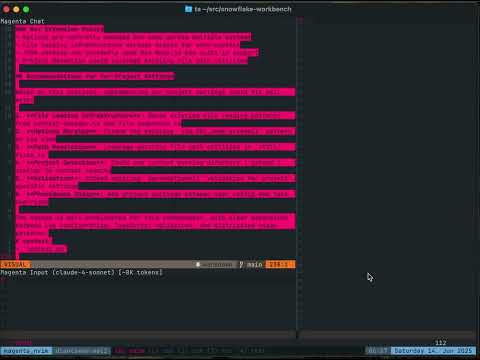
Why would I use this instead of claude code / another cli agent harness?
It's neovim, baby! Use your muscle memory to browse agent output, gather context, and edit your prompt. Jump into a buffer to fix errors or redirect the agent — the diff of your edits will be sent to the agent in the next message.
Magenta is fully transparent: you see everything the agent sees — prompts, reminders, tool descriptions — and can customize all of it. Edits use EDL, a purpose-built DSL that's far more token-efficient than claude code's str_replace. The useful parts of claude code (context management, sub-agents, skills, custom agents) are all present, so you won't miss anything.
And also apparently the code quality is a lot better?
Why would I use this instead of other neovim AI plugins?
I haven't actually used other neovim AI plugins in a while, so take this with a grain of salt. My feeling is that magenta provides a richer set of features, nicer UI and more customizability than other plugins. Using a typescript core means we can leverage the anthropic sdk and libraries like anthropic's sandbox-runtime, which greatly speeds up development. The distinguishing features:
- Edit Description Language (EDL): A small DSL that's more expressive than string match/replace and often uses far fewer tokens to express edits, since it doesn't have to accurately re-type large swaths of text when making large edits.
- OS-level sandboxing: By default we use anthropic's sandbox-runtime to run the agent in an OS sandbox (seatbelt on macOS, bubblewrap on Linux) with configurable filesystem and network policies. Fewer operations require manual approval, leading to less alert fatigue.
- Docker sub-agents: Spawn isolated agents in Docker containers for parallel, unsupervised work.
- Per-thread buffers: Each thread is its own buffer, so you can use buffer navigation, jump lists, and pickers to jump between threads.
- Declarative TUI rendering: A VDOM-like / react-like system (code) for rendering text into neovim buffers supports a rich display with expanding sections, navigation UI, and in-display-window approval dialogues.
- UX polish: Chimes and terminal bells integrate nicely with things like multiplexing neovim sessions in tmux.
- Customizable agents: Agent system prompts are markdown files on disk (
~/.magenta/agents/or.magenta/agents/). Override or create new agent personalities without touching code. - Auto-compaction: Chunked incremental summarization with accurate token counting keeps long threads manageable without losing important context.
- TEA architecture: State is managed via an elm-inspired architecture (code), making the plugin easy to understand, extend, and test.
- Full end-to-end testing: A complete integration test setup with TypeScript async/await makes writing readable tests easy. The plugin is well-tested across unit, integration, and docker levels.
- TypeScript + official SDKs: Using the Anthropic SDK directly means streaming, tool use, and caching just work. Async/await makes side-effect chains straightforward.
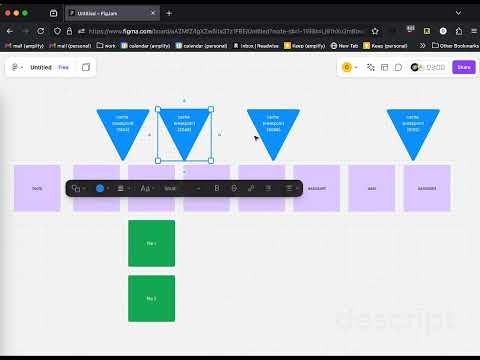
- Smart prompt caching: Pinned files only move up in message history when they change, maximizing Anthropic's prompt cache hit rate. Cache breakpoints are placed strategically.
- Transparency: Raw tool use requests/responses, stop reasons, and token usage are all visible. You can see everything the agent sees and manipulate it.
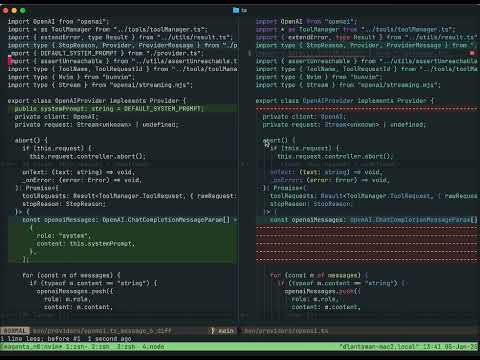
- File snapshots: Automatic file state capture before edits enables accurate before/after diffs and better review.
Updates
Apr 2026
- Per-thread buffers: each thread now gets its own chat and input buffer. Switching threads swaps buffers in place, preserving scroll position and unsent input.
- Thread overview improvements: collapsible subtrees, sort by recent activity, sandbox violation indicators, and
ddbinding to delete thread subtrees. - Terminal bell notifications: ring terminal bell on agent completion and when agent pauses for user permission, so you can work in another window.
- Customizable agents: agent system prompts are now markdown files on disk (
~/.magenta/agents/or.magenta/agents/), making them easy to customize and override. docstool: renamed fromlearn, now surfaces built-in:help magentadocs and discovers user-created documentation.- Docker skills loading: skills now load inside Docker subagents via the FileIO interface.
- Sandbox improvements:
- Per-thread-tree sandbox bypass toggle for trusted threads.
requireApprovalPatterns: regex patterns (e.g.git\s+push) that trigger approval prompts before running a command. Defaults to["git\\s+push"].- Configurable bwrap violation patterns, hot-reloadable.
- OS-level sandboxing via
@anthropic-ai/sandbox-runtime(seatbelt on macOS, bubblewrap on Linux) with sensible defaults protecting credentials and dotfiles.
- Security:
.magenta/options.jsonis now protected from agent tampering. - Branchless docker: simplified container provisioning to directory-based (no git branches), with rsync-based file sync on teardown. Docker config is now specified inline in
spawn_subagentstool calls instead of.magenta/options.json. - Agent tier system: agents have
leaf,thread, ororchestratortiers that control spawn permissions. Newworktreeorchestrator agent replaces the conductor. New:Magenta agent <name>command. - Abort improvements: partial stdout/stderr included in bash tool abort responses; user abort message appended to thread.
- Exponential backoff retry for Anthropic 429/529 rate limit errors.
- Simplified file I/O: disk-first approach, removed BufferTracker complexity.
- Expand/collapse for subagent progress and result rows in the chat view.
- Test segmentation:
TEST_MODEenv var splits tests into sandbox (local) and full-capabilities (docker) modes. Newtests-in-sandboxsubagent for fast local feedback. - Renamed the
docstool tolearntool. - Claude Code keychain auth: new
authType = "keychain"profile option (macOS) reuses the Anthropic Console API key that Claude Code stores in the login Keychain, for users on the "Anthropic Console Account (API usage billing)" sign-in mode.
Mar 2026
- Dev containers: spawn Docker sub-agents that work on isolated branches in containers. Dockerfile-based, no bind mounts, Docker layer caching for fast startup.
Feb 2026
- Type-checking now uses
tsgo(TypeScript native Go compiler from@typescript/native-preview) for ~5x faster checks. - Refactored tool architecture: separated tool execution from rendering, extracted shared capabilities (permissions, file I/O, shell) into a
capabilities/layer. This decouples tools from neovim, moving towards being able to run it via server/client architecture, and dev container support. - New sandbox permission system: OS-level sandboxing via
@anthropic-ai/sandbox-runtimefor shell commands, with application-level pre-flight checks for file I/O. Configurable viasandboxconfig (filesystem and network restrictions). Graceful fallback on unsupported platforms. - Auto-compaction with chunked incremental summarization and accurate token counting via
countTokensAPI. - Introduced the edit description language (edl) tool, which subsumes the insert and replace tools.
- Introduced explore subagent, blocking subagents for better token economy and exploration speed.
- I decided to drop next edit prediciton and inline edits. I think I'm going to pivot this in a slightly different direction - for more power around unsupervised agent mode and managing teams of agents.
Jan 2026
- Major provider refactor: messages now stored in native format, eliminating lossy round-trip conversions and improving cache reliability
- Reworked
@fork: it now clones the thread. Can now fork while streaming or pending tool use, and continue the original thread afterward - Bash command output now streams to temp files (
/tmp/magenta/threads/...) with abbreviated results sent to the model - New
@compactcommand for manual thread compaction - Tree-sitter minimap: large files now show structural overview (functions, classes) instead of just first 100 lines
- Improved abort handling: cleaner tool lifecycle management
- README split into
:help magentadocumentation - Breaking: Dropped support for non-Anthropic providers (openai, bedrock, ollama, copilot). I don't use them and maintaining them slowed me down in exploring new features. The new provider architecture is simpler - contributions to re-add providers welcome!
Dec 2025
- Enhanced command permissions system with argument validation and path checking
- Improved file discovery with
rgandfdsupport
Nov 2025
- System reminders for persistent context
- Skills support (
.claude/skillsdirectory)
Aug 2025
- PDF page-by-page reading
- Claude Max OAuth authentication
- Configurable chime volume
@forkfor thread forking with context retention
Jul 2025
-
Input buffer completions with nvim-cmp
-
Thinking/reasoning support
-
Remote MCP support (HTTP/SSE)
-
Fast models and
@fastmodifier -
spawn_foreachfor parallel sub-agents
Jun 2025
- Sub-agents for parallel task delegation
- Image and PDF support
- Copilot provider
May 2025
- Thread compaction/forking
- Smart context diffing
- Streaming tool previews
- Web search and citations
Earlier
Installation
Requirements: Neovim 0.12.1+, Node.js v24+ (node --version), nvim-cmp
Recommended: fd and ripgrep for better file discovery
Using lazy.nvim
{
    "dlants/magenta.nvim",
    lazy = false,
    build = "npm run build",
    opts = {},
},
Using vim.pack (Neovim 0.12.1+)
Neovim 0.12.1 includes a built-in package manager. Add to your init.lua:
vim.api.nvim_create_autocmd("PackChanged", {
  callback = function(ev)
    if ev.data.spec.name == "magenta.nvim" and ev.data.kind ~= "delete" then
      vim.system({ "npm", "run", "build" }, { cwd = ev.data.path }):wait()
    end
  end,
})

vim.pack.add({ "https://github.com/dlants/magenta.nvim" })

require('magenta').setup({})
Configuration
Quick Setup
require('magenta').setup({
  profiles = {
    {
      name = "claude-opus",
      provider = "anthropic",
      model = "claude-opus-4-7",
      fastModel = "claude-haiku-4-5",
      apiKeyEnvVar = "ANTHROPIC_API_KEY"
    }
  }
})
Key Features
For any of the below, you can also just ask magenta to explain.
- Profiles & providers — configure models, API keys, and provider options. docs ·
:help magenta-providers - Project settings — per-project
.magenta/options.jsonfor profiles, auto-context, skills paths, and MCP servers. docs ·:help magenta-config - Skills — markdown files in
~/.magenta/skills/,.magenta/skills/,~/.claude/skills/, or.claude/skills/that teach the agent project-specific knowledge. Supports suppressing project-level skills by name when shared configs collide with personal ones. docs ·:help magenta-skills - Sandbox — OS-level sandboxing (seatbelt/bubblewrap) with configurable filesystem, network, and approval policies. docs ·
:help magenta-sandbox - MCP servers — connect to local or remote MCP servers for additional tools. docs ·
:help magenta-mcp - Docker subagents — spawn isolated agents in Docker containers for parallel, unsupervised work. docs ·
:help magenta-docker
Usage
| Keymap | Description |
|---|---|
<leader>mt |
Toggle chat sidebar |
<leader>mf |
Pick files to add to context |
<leader>mn |
Create new thread |
<leader>mp |
Paste clipboard image (in input buffer) |
Input commands: @fork, @file:, @diff:, @diag, @buf, @qf, @fast
For complete documentation:
:help magenta-commands- All commands and keymaps:help magenta-input-commands- Input buffer @ commands:help magenta-tools- Tools and sub-agents:help magenta-mcp- MCP server configuration
Development
The install hooks above run npm run build to produce a single-file bundle at dist/magenta.mjs. Neovim invokes this bundle directly, which keeps startup fast by avoiding thousands of file opens through the TypeScript source tree.
When hacking on the plugin, set MAGENTA_DEV=1 in your shell (or your neovim launcher) to skip the bundle and run the TypeScript source directly via node --experimental-transform-types:
MAGENTA_DEV=1 nvim
If dist/magenta.mjs is missing (e.g. you cloned the repo without running the build), the plugin automatically falls back to source mode and prints a one-line warning.
Contributions
README copy captured when this server was indexed; it may lag the repository. The original is authoritative.